
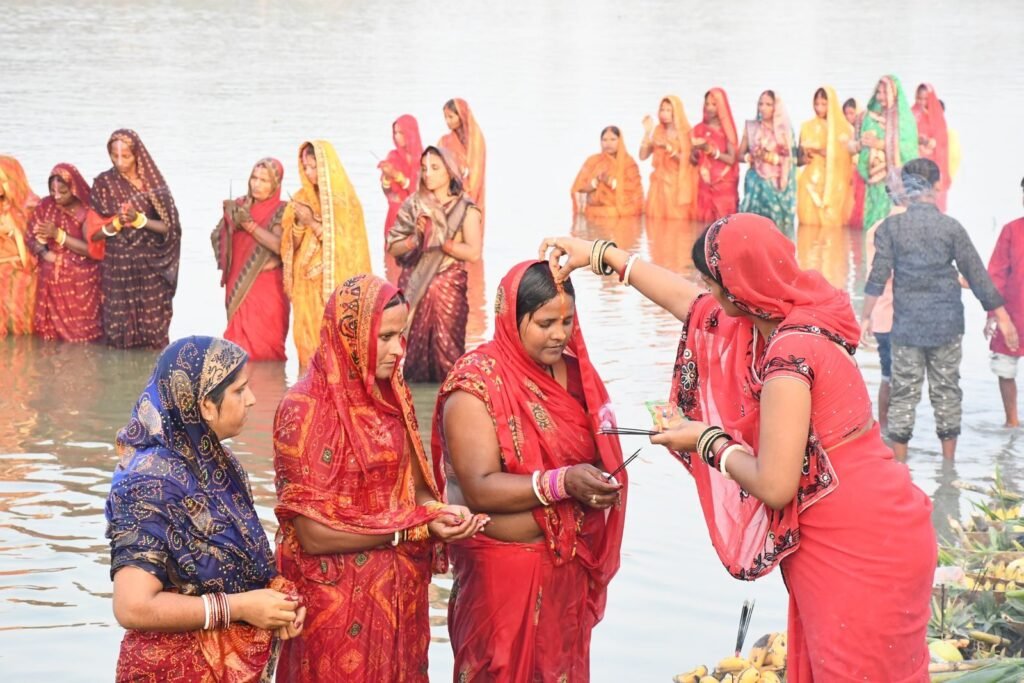
Quick answer: Chhath Puja 2027 runs from Tuesday 2 to Friday 5 November 2027, as per the panchang. The main evening offering to the setting sun (Sandhya Arghya) is on Thursday 4 November, and the dawn offering (Usha Arghya) that ends the fast is early on Friday 5 November. Reach the ghat well before sunset, carry nothing you can’t hold close in a crowd, and never take a spot reserved by a family for their vrati.
Chhath Puja 2027 runs over four days, from Tuesday 2 to Friday 5 November. The day most people mean when they say “Chhath” is Thursday 4 November, when families gather at rivers and ponds to offer arghya to the setting sun. They come back before dawn on Friday for the rising sun, and the fast ends. (In 2026, Chhath ran from 13 to 16 November.)
If you’re planning to be at a ghat, these are the dates and times to hold on to:
- Tue 2 November 2027: Nahay Khay, the first day.
- Wed 3 November: Kharna, a day-long fast that ends in the evening.
- Thu 4 November: Sandhya Arghya at sunset. Check the exact local sunset time for Patna or Delhi in a panchang nearer the date.
- Fri 5 November: Usha Arghya at sunrise. Check the local sunrise time nearer the date too.
- These dates are calendar-calculated from the panchang (samvat.in, mypanchang). Check the exact Shashthi tithi timing on Drik Panchang closer to the festival.
Sunset and sunrise shift by a few minutes from one town to the next, and a riverbank with a clear view of the horizon is different from a city centre. Families usually reach the ghat well before the time, so you should too.
In this guide
Why the setting sun matters at Chhath Puja
Chhath Puja is a festival for Surya, the sun god, and for Chhathi Maiya, who is believed to protect children and give them long, healthy lives. It’s the biggest festival of the year for many families in Bihar, and it’s also kept in Jharkhand, eastern Uttar Pradesh and the Terai of Nepal, and wherever people from these places have settled.
What sets it apart is simple. Most festivals greet the rising sun; Chhath also thanks the setting one. Bihar Tourism calls it the only occasion on which both are worshipped. The main offering needs no idol and no priest. The person keeping the fast, called the vrati and most often a woman, stands in the water and makes the offering herself, with the family around her on the bank.
There’s also a smaller Chaiti Chhath in spring, in the month of Chaitra. The November one, in Kartik, is the big one.
What happens on each of the four days of Chhath Puja
Day 1, Nahay Khay (2 November in 2027). The name means “bathe and eat”. The vrati bathes in a river or pond, often brings Ganga water home, and the house is cleaned from top to bottom. She eats one simple meal, usually rice and lauki (bottle gourd), cooked without onion or garlic.
Day 2, Kharna (3 November). She fasts through the day and breaks the fast after evening puja with kheer made with jaggery (often called rasiya), roti and fruit. That kheer is shared with family and neighbours. After this meal, the hardest part begins: a nirjala fast, without food or even water, that lasts about 36 hours.
Day 3, Sandhya Arghya (4 November). The day goes in making prasad, above all thekua, and packing it into bamboo baskets with fruit, sugarcane and coconut. In the afternoon the family walks to the ghat, and folk songs for Chhath are sung along the bank. As the sun goes down, the vrati stands in the water and makes her offering.

That night many families keep the Kosi ritual at home or in the courtyard: sugarcane stalks are tied into a canopy and clay lamps are lit beneath it, around the baskets of prasad.
Day 4, Usha Arghya (5 November). Everyone is back at the water in the dark, waiting for the first light. Once the arghya to the rising sun is made, the vrati breaks her fast (parana), and prasad is shared with neighbours and relatives. If someone offers you some, accept it with both hands or your right hand.
Thekua and the other things in the basket
Thekua is the taste of Chhath for most people from Bihar. It’s a hard, crunchy biscuit of wheat flour, jaggery and ghee, shaped by hand or in a mould and deep-fried. Because the whole festival is about purity, it’s traditionally made in a freshly cleaned kitchen, often on a clay chulha, and nobody eats any until it has been offered.

Alongside it you’ll see bananas, sugarcane, coconuts and other seasonal fruit, and in many homes small laddoos of rice flour and jaggery. In the days before Chhath, markets sell the bamboo baskets and sugarcane, and thekua is sold ready-made too.
Watching Chhath Puja at the Patna ghats
Patna, on the Ganga, is where the festival is at its largest. The banks fill from mid-afternoon on the Sandhya Arghya day, and again from well before dawn the next morning. Expect to walk the last stretch: some big ghats are a long way from where vehicles can stop. Local reports in 2026 described a walk of about 2 km to Collectorate Ghat, either from opposite the Bankipore Club or along the Ganga Path.
Not every ghat is safe. The river shifts, and each year the city declares some ghats dangerous and closes them. For Chaiti Chhath in March 2026, for example, the Patna Municipal Corporation prepared 49 ghats and sealed eight, according to local reports. The list for November is issued separately, a few days before the festival, so check it before you go and stick to the ghats that are open and barricaded.
A few things make the day easier for you and for the families around you:
- Get there early and stay above the waterline. The steps and the water’s edge belong to the vratis.
- Leave your shoes away from where offerings are kept, and don’t step over or touch the baskets.
- Ask before photographing anyone close up, especially a woman standing in the water. Wide shots of the crowd are a different matter from a lens in someone’s face.
- Don’t bring non-vegetarian food or alcohol anywhere near the ghat.
- Carry a warm layer for the dawn arghya. Early November mornings by the river feel cool after a mild afternoon.
Getting to Patna that week is the hard part. Trains into Bihar are full for days either side of Chhath Puja, because so many people go home for it, and Indian Railways adds festival special trains every year. Book as early as you can, and keep a flight or a train to Gaya or Varanasi in mind as a back-up. If you’re staying on, our guide to the 20 best places to visit in Bihar has distances from Patna for Nalanda, Rajgir and Bodh Gaya.
Chhath Puja away from Bihar: Delhi, Kolkata and Varanasi
You don’t need to be in Bihar to see it. In Delhi, families gather on the Yamuna and at ghats and ponds set up across the city. The Delhi government said in 2025 that it was building 17 “model” Chhath ghats along the Yamuna, with tents, lighting and toilets. In Kolkata, the banks of the Hooghly near Howrah Bridge are busy, and sunset comes earliest there of the three cities. In Varanasi the ghats along the Ganga fill up too; our Varanasi travel guide will help you find your way around them.
Wherever you go, the rhythm is the same: an afternoon of waiting and singing, the offering as the sun touches the horizon, and a cold, quiet walk back down to the water before dawn. For the official background on the festival, see Bihar Tourism’s Chhath Puja page.
Frequently asked questions
When is Chhath Puja 2027?
From Tuesday 2 to Friday 5 November 2027, as per the panchang. Sandhya Arghya is on the evening of Thursday 4 November and Usha Arghya at sunrise on Friday 5 November. In 2026 it ran from 13 to 16 November.
What is the main day of Chhath Puja?
The third day, Sandhya Arghya, when families offer arghya to the setting sun at rivers and ponds. In 2027 it falls on Thursday 4 November.
Can visitors watch Chhath Puja at the ghats?
Yes, respectfully. Arrive early, stay out of the way of the vratis and their families, and ask before photographing anyone.
Where is the best place to see Chhath Puja?
Patna’s Ganga ghats are the best known, along with ghats across Bihar, eastern Uttar Pradesh, Jharkhand and in Delhi along the Yamuna.
What is thekua?
A sweet fried wheat-and-jaggery biscuit offered as prasad at Chhath. See our thekua recipe to make it at home.
Cover photo by Amit Rai on Pexels (source). Crowd by the lake: Dainik Tales on Pexels (photographer). Fruit offering: Himanshu Singh on Pexels (source).


Pingback: Famous Food of Bihar: 12 Best Dishes Beyond Litti Chokha