
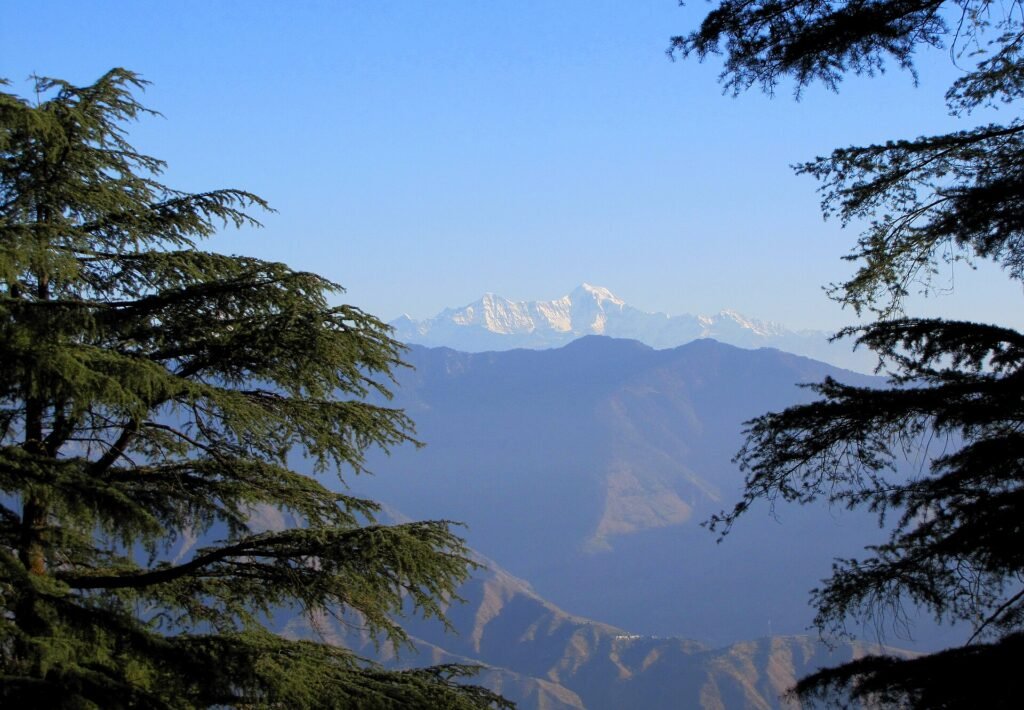
Quick answer: For cleaner air within a day’s drive of Delhi, go high, not just far: hill towns around 2,000 m such as Shimla, Mussoorie–Landour and Nainital usually have far lower AQI than Delhi in November, while foothill cities like Dehradun can still be hazy. Check the latest AQI before you leave, plan for at least 2–3 nights, and confirm any GRAP vehicle restrictions before driving out.
The best clean air places near Delhi are high up, not just far away. When the AQI at home starts with a 3 or a 4, a hill town at about 2,000 metres will usually give you much cleaner air. A town at the bottom of the same hills often won’t.
Maybe it’s a child’s cough that won’t settle, or a parent who has stopped going out for the morning walk. On 2 November 2026, most of Delhi’s monitors were above 300, with Rohini at 396, and by 6 November the city average had reached 389, with Rohini and IIT Delhi at 474. If you’re thinking of leaving for a few days, these are the three clean air places near Delhi we’d look at first:
- Shimla (about 2,200 m): the only one of the three where we found regular public air readings.
- Mussoorie and Landour (about 2,000 m): the quickest to reach from Delhi.
- Mukteshwar (about 2,300 m): the quietest, and the longest drive.
In this guide
Why height matters more than distance
In winter, cold air sits near the ground with warmer air above it. That warm layer works like a lid, so smoke and dust can’t rise and spread out.
In summer, pollution can mix up to about a kilometre above the ground. In winter that space can shrink to a few hundred metres, so the same dirt fills a much smaller box. The Himalayas also stop the air from moving north, so the haze spreads along the plains and collects against the first hills. That’s why the clean air places near Delhi are all up in the hills, not just further out on the plains.

You can see the whole plan in that picture. You don’t need to go a long way. You need to get above the grey.
What AQI readings in hill stations near Delhi really show
“Hill station” doesn’t always mean clean air, so it helps to look at numbers. India’s AQI scale runs like this: 0–50 good, 51–100 satisfactory, 101–200 moderate, 201–300 poor, 301–400 very poor, and above 400 severe.
Diwali is one of the hardest days of the year for air, which makes it a fair test. Here is how towns read on Diwali day in Uttarakhand and in Himachal in October 2025:
- Foothills and edge of the plains: Haldwani 198, Roorkee 190, Kashipur 168, Una 140, Dehradun 128.
- Uttarakhand hills: Nainital 111, Tehri 66.
- Himachal hills: Dharamsala 120, Manali 62, Shimla 57.
Rishikesh read just 54 that day, even though it sits low. That’s one day’s number, so we wouldn’t plan a trip around it.
The pattern is clear enough, but there are three things a list of clean air places near Delhi won’t tell you:
- Foothill cities can turn bad. On 17 December 2025, Dehradun read 294, and the head of Doon University’s pollution centre said it crosses 300 at night.
- Height is not a promise. In a dry, cold spell in November 2025, Shimla read 133. That’s moderate, not mountain-fresh, though nowhere near what Delhi was breathing.
- Hill towns burst crackers too. Shimla read 19 about a week before Diwali 2025 and 57 on the day.
We also couldn’t find a public monitor for Mukteshwar, Landour, Kasauli or Lansdowne. So we can’t give you an AQI for them, and you should be careful of anyone who does. The nearest town with a reading is only a clue.
Five clean air places near Delhi, compared
Here is how the five clean air places near Delhi on our list compare on height, drive time and the closest public air reading. Drive times are rough and assume a clear road out of the city.
| Place | Height | From Delhi by road | Nearest air reading |
|---|---|---|---|
| Shimla | about 2,200 m | about 350 km, 7–9 hours | Its own: 57 to 133 in the readings above |
| Mussoorie–Landour | about 2,000 m | about 250 km, 4–5 hours | None found up here; Dehradun below read 128 to 294 |
| Mukteshwar | about 2,300 m | about 350 km, 8–9 hours | Nainital: 111 |
| Kasauli | about 1,800 m | about 290 km, about 6 hours | None found; Parwanoo below was moderate |
| Lansdowne | about 1,700 m | about 270 km, 6–7 hours | None found |
Shimla is the safe choice if you want a town with real readings, plenty of rooms and shops, and a hospital nearby. It’s also a busy town, so a stay a little away from the centre makes sense. There’s no direct train from Delhi: you go to Kalka and take the toy train or a taxi from there. Our Himachal Pradesh travel guide covers the rest of the state.

Mussoorie and Landour are the easy answer if you only have a long weekend. The 213 km Delhi–Dehradun Expressway opened in April 2026, and from Dehradun it’s about 35 km of hill road, which can take an hour or more. The one mistake is stopping in Dehradun itself. Drive through and keep climbing. Landour, above Mussoorie, gets you higher still, and away from the Mall Road.
Mukteshwar is for people who want to stay still for a few days. The railhead is Kathgodam, a little over 70 km away, and the road passes through Haldwani, the worst reading on our list. That’s fine for a passing car. It’s a small place, so bring any medicines you need with you.
Kasauli is close and simple: the Shatabdi to Kalka, then a taxi. But it’s the lower of the Himachal options, and it sits above the factory belt around Parwanoo and Baddi. We’d keep it as a backup.
Lansdowne is the gentlest of the five, and we’ve covered the route in our easy drives from Delhi. If you’d rather be in a village than a town, our list of offbeat village homestays has other ideas. And if you’re hoping for snow as well, our Uttarakhand snow guide explains which places get it first.
Check these before you drive out of Delhi
Delhi’s winter rules changed on 1 November 2026, and a few of them can spoil a trip before it starts.
- Pollution certificate: pumps in Delhi can refuse fuel to any vehicle without a valid PUC. Renew it before you leave.
- Cars registered outside Delhi: from 1 November 2026 to 31 January 2027, vehicles that don’t meet BS-VI can’t run in Delhi. CNG and electric vehicles are exempt. Not every report spells out how this applies to private cars, so if yours is an older Noida or Gurugram car, confirm with Delhi Traffic Police or plan a route around the city.
- GRAP stage: Stage I was in force on 2 November 2026. At Stage III, BS-III petrol and BS-IV diesel cars are restricted in Delhi, Gurugram, Faridabad, Sonipat, Ghaziabad and Noida. Stages can change overnight, so check CAQM the day before.
- Timing around Diwali: if you can, get to the hills before Diwali night on 8 November 2026 and stay a day or two after it.
- Morning haze: smog and fog can cut visibility on the plains, so start after it gets light instead of in the dark.
Going with a child, an older parent or someone with asthma
A few days in the hills is a break, not a treatment. If someone in your family is unwell, speak to their doctor before you book, and mention the cold as well as the air. Cold air can set off asthma in some people, and hill nights get sharp in November.
- Pack inhalers and regular medicines in your hand bag, not in the boot.
- Keep a well-fitted N95 mask handy for fuel stops and traffic on the plains.
- Never sleep in a closed room with a coal or wood heater. An angithi gives off carbon monoxide, which you can’t see or smell and which can kill. Ask your homestay for an electric heater and extra blankets instead.
Check the number on the morning you leave
Before you set off for any of these clean air places near Delhi, open the CPCB live AQI map and look at Shimla and Dehradun. If Dehradun is poor, don’t worry; just don’t stay there. If Shimla is moderate or better, you’re going to a far better place than the one you’re leaving.
One last thing. Between October and February, stand on a ridge in Mussoorie or Shimla at dusk and look west. You may see a false horizon, a band of colour low in the sky called the winterline. Nobody is fully sure what causes it, but one idea is that dust and smog from the plains meet the cold mountain air. So what you left behind may be the prettiest thing you see all week, from a long way above it.
Common questions about escaping Delhi’s smog
Which hill station near Delhi has the cleanest air?
Of the clean air places near Delhi that have a public air monitor, Shimla (57), Manali (62) and Tehri (66) had the lowest readings on Diwali day 2025. Shimla is the closest of the three to Delhi. Landour and Mukteshwar may be just as clean, but we couldn’t find a monitor there to show it.
What is the nearest clean air escape from Delhi?
Mussoorie and Landour are the closest clean air places near Delhi, about 250 km away. With the Delhi–Dehradun Expressway, the drive takes roughly 4–5 hours. Drive through Dehradun rather than stopping there.
Is Dehradun a good place to escape Delhi’s pollution?
Not reliably. It read 128 on Diwali day 2025, which is moderate, and 294 on 17 December 2025, close to the “very poor” range. Use it as a gateway and keep climbing.
Can I reach these places without a car?
Yes, by train plus a taxi or bus for the last stretch. Go to Kalka for Shimla and Kasauli, Dehradun for Mussoorie, Kathgodam for Mukteshwar, and Kotdwar for Lansdowne.
Which months are worst for air in Delhi?
Usually late October to February. In the last season, the city’s Stage II pollution curbs ran from 19 October 2025 to 18 February 2026. That’s also the window when a few days in the hills helps most.
Photos: Himalayan view from Landour in November (featured) by Paul Hamilton, CC BY-SA 2.0 (source). Seasonal haze over northern India by MODIS Land Rapid Response Team, NASA GSFC, public domain (source). Shimla skyline after snow by UnpetitproleX, CC BY-SA 4.0 (source). Himalayas from near Mukteshwar by Mike Prince, CC BY 2.0 (source). All via Wikimedia Commons.


