

Quick answer: Kullu Dussehra 2026 ended on 27 October. Kullu Dussehra 2027 is expected to run for seven days from around Sunday 10 October 2027, starting the day after Vijayadashami (Saturday 9 October 2027), on the Dhalpur ground in Kullu town. Official dates are announced closer to the festival on the official Kullu Dussehra website. If you can go for only one day, make it the opening day, when Lord Raghunath’s chariot is pulled across Dhalpur.
Kullu Dussehra looks nothing like Dussehra elsewhere in India: there’s no Ramlila and nobody burns a Ravan effigy. Instead, hundreds of village deities are carried into town on people’s shoulders to honour Lord Raghunath, and the whole valley comes with them. Once you know that, the week makes sense, and choosing your day becomes easy.
- Expected dates: about 10 to 16 October 2027, the week after Vijayadashami (provisional until announced).
- Where: Dhalpur ground, in the middle of Kullu town, beside the Beas.
- Best single day: the opening day, for the chariot procession (rath yatra).
- Quieter days: the middle of the week, when the deity camps and fair are easiest to walk around.
- Last two days: Muhalla (deities gather to honour Raghunath ji), then the Lanka Dahan by the Beas.
In this guide
Which day of Kullu Dussehra should you go?
If you can only manage one day, make it the first. The festival starts once Hidimba Devi, the goddess of Manali, has arrived in Kullu. In the afternoon, Lord Raghunath is brought from his temple to Dhalpur and placed in a large wooden chariot.
Then people take hold of the ropes and pull the chariot across the ground by hand, with the palanquins of the village deities moving alongside. This is the moment most visitors come for, so it also brings the biggest crowd of the week. Get to Dhalpur early if you want to see the chariot rather than the backs of other people’s heads.
The middle days are calmer. The deities stay in their camps on the ground, each with its own musicians playing the dhol, nagara, shehnai and long ransingha horns. Dhalpur becomes a fair, with stalls selling Kullu shawls, caps and food, and cultural programmes in the evenings. Look out for the Kullu Nati, a slow folk dance performed in long lines. A mass Nati at the festival is recognised by Guinness World Records. If big crowds wear you out, these are the easiest days to walk around.
On Muhalla, the second-last day, the deities gather to pay their respects to Raghunath ji. It’s one of the best chances to see many palanquins in one place, and the traditional Lalhri dance is held that night at the Raja’s camp.
On the last day, the chariot is pulled to the bank of the Beas and a heap of dry brushwood, standing for Ravan’s Lanka, is set alight. This is the Lanka Dahan, and it’s the only burning you’ll see all week. Raghunath ji then goes back to his temple in Sultanpur, and the village deities begin the trip home.
How the week runs, day by day
Here’s how this year’s week lines up with the 21 to 27 October programme. Exact timings depend on the deities and their priests, so ask locally on the day.
- Day 1: Hidimba Devi arrives from Manali, and Lord Raghunath’s chariot is pulled across Dhalpur in the afternoon. The biggest crowd of the week.
- Days 2 to 5: the deities sit in their camps, the fair is in full swing, and there are cultural programmes in the evenings. Kullu Nati performances turn up through the week.
- Day 6: Muhalla, when the deities gather to pay their respects to Raghunath ji, followed by the Lalhri dance at night.
- Day 7: the chariot goes to the bank of the Beas for the Lanka Dahan, and Raghunath ji returns to his temple in Sultanpur.
Why Kullu crowns Raghunath instead of burning Ravan
The story goes back to Raja Jagat Singh, who ruled Kullu in the 17th century. Local tradition says he wronged a Brahmin and fell under a curse. To make amends, he had an idol of Lord Raghunath (Rama) brought from Ayodhya, put it on his throne as the real ruler of the valley, and ruled only as its servant. Some tellings say the idol stayed at Manikaran for a while before it reached Kullu.
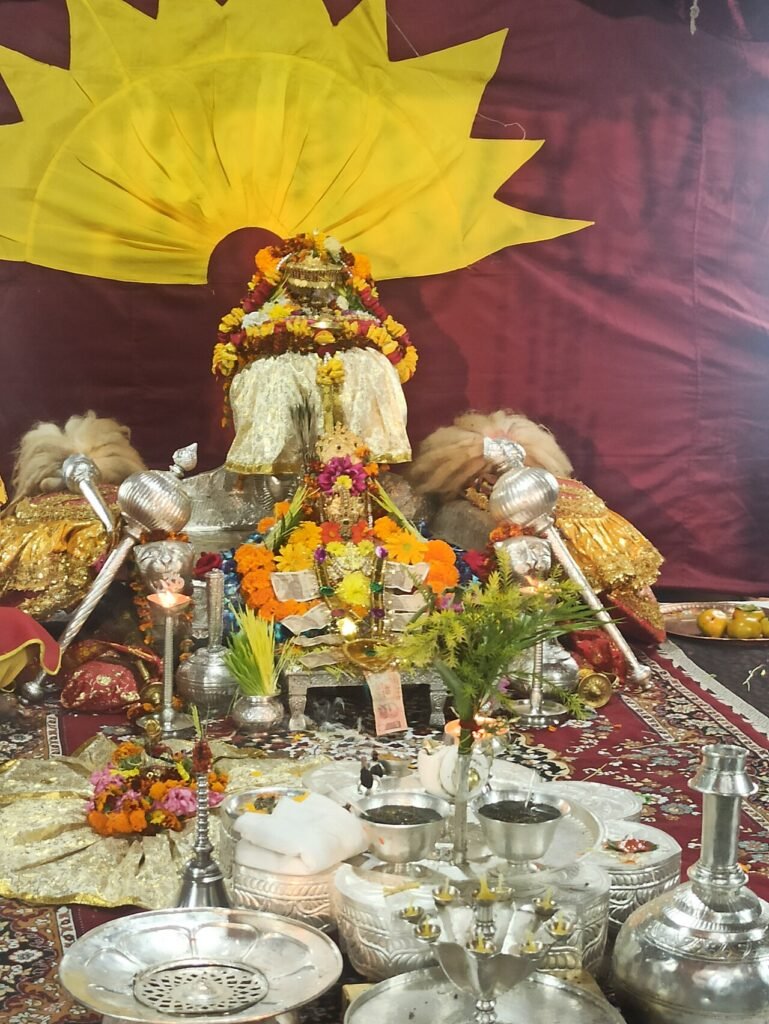
The king then invited the valley’s deities to Dhalpur to honour Raghunath, and they have come back every Dussehra since. So what you’ll be watching isn’t a retelling of the Ramayana. It’s a valley’s gods gathering, once a year, around the one their king made ruler.
What to eat and buy at the Dhalpur fair
Between the deity camps, Dhalpur turns into a long, busy market, and the food is part of the fun. In recent years visitors have queued for makki di roti with sarson ka saag, there’s usually a Tibetan food corner (think momos and thukpa), and the sweet shops do brisk business with families who have come in from the villages.
Away from the fair, look for siddu in Kullu’s small eateries. It’s a soft, steamed wheat bun, often stuffed with a walnut or poppy-seed filling and eaten hot with ghee, and it’s one of the valley’s best-known dishes.
For shopping, the Kullu shawl is the thing to bring home. It’s woven in wool with geometric bands of bright colour, and it carries a GI tag, which protects the name for shawls made in the region. The round Kullu cap with its coloured front band is the other classic, and an easy gift.
- Buy shawls from a cooperative or an established shop if you want to be sure of handloom wool. Bhuttico, the valley’s best-known weavers’ cooperative, has outlets in Kullu and Manali.
- At fair stalls, prices are open to friendly bargaining. Ask whether a shawl is pure wool, a blend or machine-made before you agree a price.
- Carry some cash. Phone payments usually work, but mobile networks slow down when the ground is crowded.
Getting to Kullu in festival week
- From Chandigarh by road: about 250 km, roughly six to seven hours via Mandi.
- From Delhi: overnight buses to Kullu and Manali are the simplest option.
- By train: Kullu has no railway station. Chandigarh is the practical place to get off.
- By air: Bhuntar Airport is about 10 km from town, but flights are few and can be cancelled in bad weather, so don’t build a tight plan around one.
The Mandi–Kullu road gets busy during the festival and can be hit by slips after rain, so start early.
Where to stay for Kullu Dussehra
Rooms in Kullu town fill up first during festival week, and prices climb. If you’re booking late, it’s often easier to stay a little further out and come in for the day.
- Kullu town: the best choice if you want to walk to Dhalpur early for the chariot or stay late for the evening programmes. Book as early as you can.
- Bhuntar, about 10 km south: handy if you’re flying in, and a short drive from town.
- Naggar, about 22 km north: quieter, set among orchards above the Beas, with the old Naggar Castle. Good if you’d rather sleep away from the crowds.
- Manali, about 40 km north: by far the most rooms, but allow extra time on festival days, when the road into Kullu is slow.
Respecting the deities, and packing for the cold
These deities belong to real villages, and their people take care of them. Ask before you photograph a palanquin up close, don’t touch them, and follow what the priests and volunteers ask.
Mornings and nights in the valley can be cold in late October, so carry a warm layer even if the afternoon feels mild. If you’re thinking of driving on towards Ladakh afterwards, the high road usually closes for winter around this time, so read our Manali to Leh road trip guide first. For a quieter base in the hills, our offbeat village homestays are worth a look.
Kullu Dussehra: quick answers
When is Kullu Dussehra 2027?
It is expected to start around Sunday 10 October 2027, the day after Vijayadashami, and run for seven days, ending with the Lanka Dahan by the Beas. Check the official website for confirmed dates.
Do you need a ticket?
No ticket is needed to watch the processions or walk around the fair on Dhalpur ground. Some evening shows may have their own seating arrangements, so ask at the venue.
Can you visit as a day trip from Manali?
Yes. Kullu is about 40 km from Manali. On the opening and closing days, leave early, because traffic into town is heavy.
Why does Kullu Dussehra start when Dussehra ends elsewhere?
It isn’t a re-enactment of the Ramayana. It’s a gathering of the valley’s deities around Lord Raghunath, and by tradition it begins after Vijayadashami and runs for a week.
Cover photo: Himalayaputra / Wikimedia Commons, CC BY-SA 4.0, cropped (source). Lanterns: Gannu03 / Wikimedia Commons, CC BY-SA 4.0 (source). Lord Raghunath: Madhrakangri / Wikimedia Commons, CC BY 4.0 (source).


