
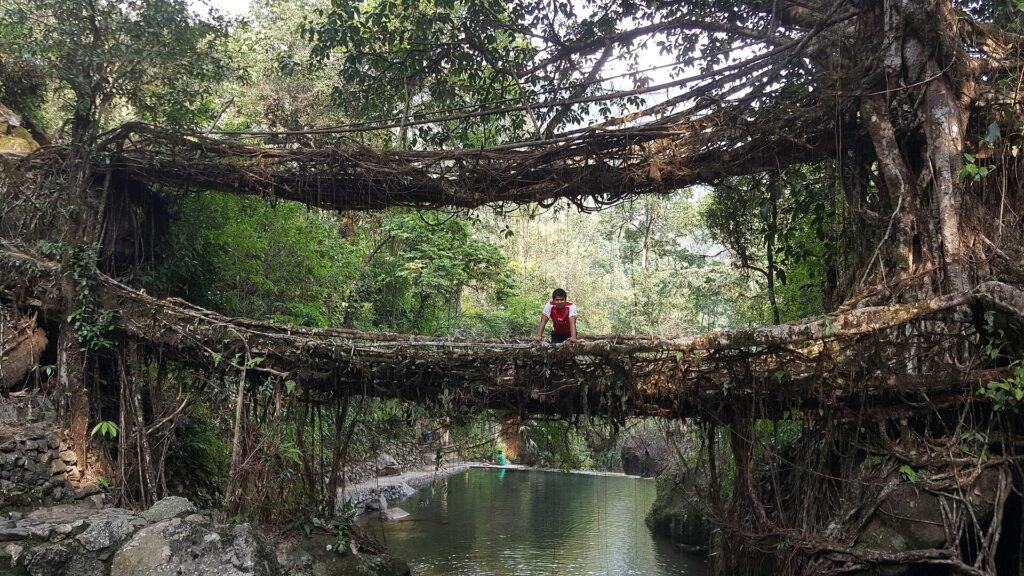
The double decker root bridge trek is the one walk almost every Meghalaya itinerary now includes, and it is harder than the photos suggest. You go down roughly 3,000 to 3,500 stone steps from Tyrna to Nongriat village, cross a couple of swaying wire bridges, and then climb every one of those steps back up. Most fit walkers manage it as a long day trip from Sohra (Cherrapunji). If your knees complain on stairs, or you want to see Rainbow Falls without rushing, a night in a Nongriat homestay is the better plan.
Here is what you need to decide before you go: whether to do it in a day or stay the night, how to reach Tyrna, what the guide rule means for you, and how to fit it into a short Shillong and Sohra trip in December, when rooms are already filling up.
In this guide
Why everyone is talking about Nongriat right now
On 19 November 2026, PTI reported that BBC Travel had named Meghalaya in its list of 20 Best Places to Travel in 2027, the only Indian destination on it. The report singled out the trek to the double-decker living root bridge at Nongriat as a signature experience, alongside sacred groves at Mawphlang, Lyrnai black pottery and Lakadong turmeric. Chief Minister Conrad K Sangma shared the news on X.
The timing matters for your plans. December is already peak season in the Khasi Hills, and on 17 November the Federation of Shillong Hotels told local media that hotels are almost fully booked till the end of December. If you are thinking about this trek for Christmas or New Year, sort out your stay first and the trek second.
One more thing worth knowing: in late August 2026, unrest in Shillong and a short blockade on the Guwahati–Shillong road led to mass cancellations. Traffic was back to normal within days, and by October the hotel federation said tourist flow had normalised. It is calm now, but glance at local news a day or two before you drive up from Guwahati.
The double decker root bridge trek at a glance
| What | Details |
|---|---|
| Start point | Tyrna village, about 30 to 45 minutes by taxi from Sohra |
| Steps | Roughly 3,000 to 3,500 down (the official page gives both figures), and the same back up |
| Trek time | About 2 hours down to Nongriat; most people take longer coming up |
| Difficulty | Moderate to hard because of the climb back, not because of the terrain |
| Guide | A registered local guide is required for treks in East Khasi Hills (district order of July 2025) |
| Best months | October to March, the dry season |
| Add-on | Rainbow Falls, about 3 km beyond the double-decker; 1 to 2 hours each way |
| Stay option | Simple homestays and guest houses in Nongriat village |
Figures on step count and timing vary from site to site. We have used the official Meghalaya Tourism page for Nongriat and the Ministry of Tourism’s rural tourism listing as the baseline, and flagged where trek reports disagree.
How to reach Tyrna from Shillong and Sohra
The double decker root bridge trek starts at Tyrna, a small village below Sohra in East Khasi Hills. There is no public transport worth relying on for an early start, so plan on a taxi.
- Shillong to Sohra: about 55 km by road, usually 1.5 to 2 hours depending on fog and traffic at the Shillong end.
- Sohra to Tyrna: 30 to 45 minutes by taxi, according to Meghalaya Tourism. Ask the driver to wait or agree a pickup time before you set off, because phone signal in the valley is patchy.
- From Guwahati: the nearest major airport and railhead. Shillong is about 100 km away, so a same-day Guwahati arrival and Nongriat trek is not realistic. Sleep in Shillong or Sohra first.
If you are doing it as a day trip, be at the top of the steps by about 8 am. That gives you a relaxed descent, time at the bridge, and a climb back up before the light goes, and in December the sun sets around 4:30 pm in the Khasi Hills.
What the double decker root bridge trek is really like
The descent is almost entirely stone steps through thick forest, with village houses, betel nut trees and the odd tea stall on the way. Going down feels easy for the first half hour, then your thighs start to notice. Take it slowly: the steps can be uneven, mossy and damp even in winter.
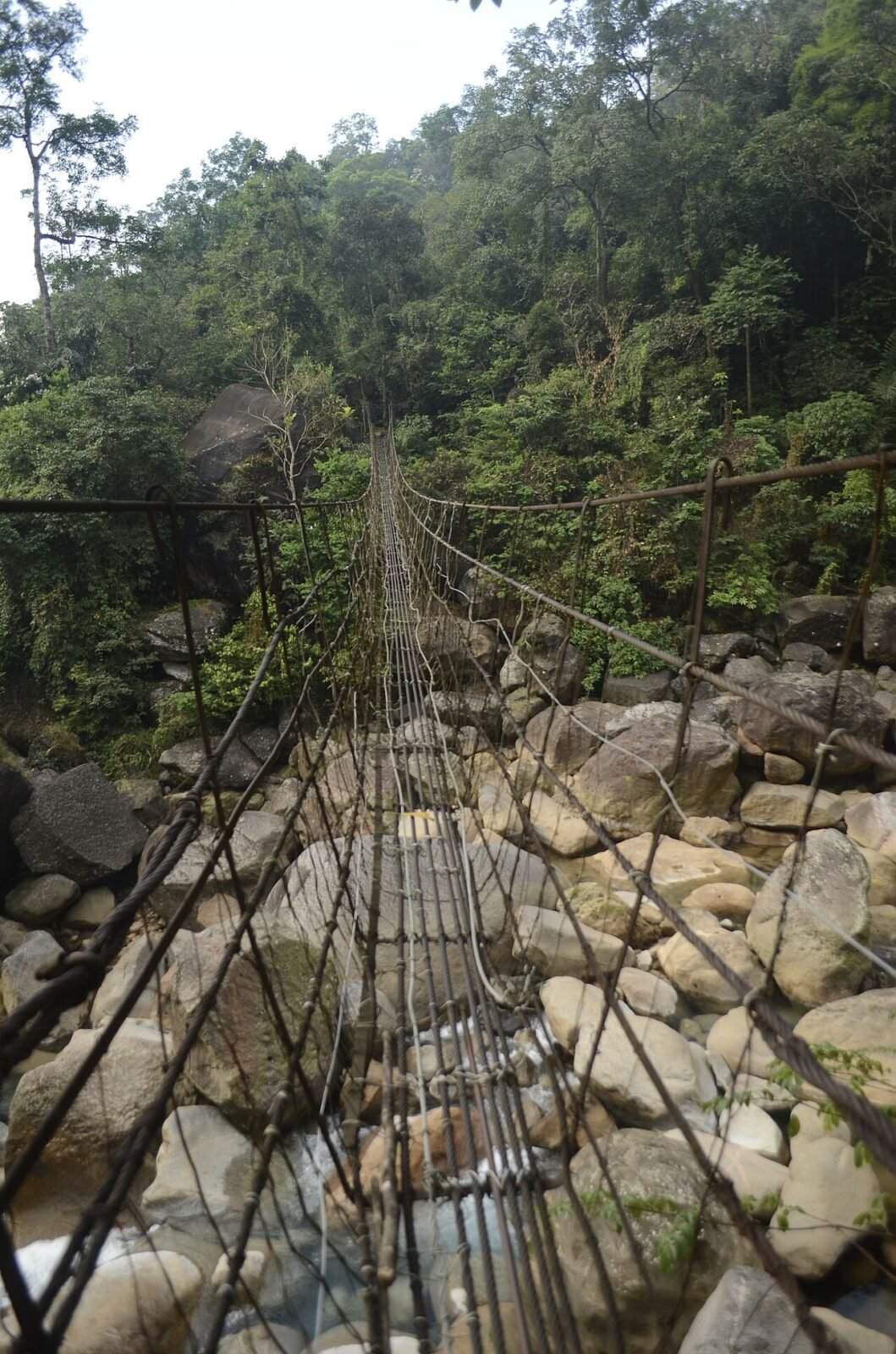
The wire bridges
Near the bottom you cross one or two steel-and-wire suspension bridges over rocky streams. They sway, and some sections have been patched over the years. Cross one person at a time, keep a hand on the cable, and don’t stop in the middle for photos. If heights bother you, tell your guide in advance; they cross these every day and will walk you through it.
Arriving at the double-decker
The bridge itself is two living root bridges, one stacked above the other, over the Umshiang stream. Khasi villagers have grown bridges like this for generations by guiding the aerial roots of rubber fig trees across a stream until they thicken and knit together. Below the bridge there are rock pools where people rest and cool their feet. Swim only where the water is calm and your guide says it is safe; after rain the current is stronger than it looks.
The climb back
This is the part most guides understate. Coming back up those 3,000-odd steps takes most people longer than the descent, often noticeably so, and it is the reason the trek earns its “hard” reputation. Budget plenty of time, take short breaks every few hundred steps rather than long ones, and keep water and a snack in your pocket rather than your bag.
Is the double decker root bridge trek hard? A quick fitness check
You don’t need trekking experience, but you do need legs that can handle a long staircase twice. A simple test: if you can climb 20 to 25 floors of stairs at your own pace without needing to stop for long, you will manage. If that sounds unpleasant, you can still do it, just plan for an overnight stay.
Think twice, or choose an easier root bridge, if you:
- have knee, hip or heart problems that stairs make worse
- are travelling with very young children who can’t walk most of the way themselves
- are short on time and would be rushing the climb back in the dark
Easier alternatives exist. The single-level root bridges near Mawlynnong and Riwai involve a much shorter walk, and you still get a good look at how living root bridges are built. You won’t see the double-decker, but you won’t spend the next two days limping either.
Day trip or a night in Nongriat?
This is the real decision, and it shapes the rest of your Sohra plans.
| Day trip | Overnight in Nongriat | |
|---|---|---|
| Best for | Fit walkers on a tight schedule | Slower walkers, photographers, anyone who wants Rainbow Falls |
| Pace | Down, an hour at the bridge, back up | Down in the afternoon, Rainbow Falls next morning, up by lunch |
| Crowds | You arrive with the mid-morning crowd | Early morning at the bridge is far quieter |
| Comfort | Your own hotel in Sohra or Shillong | Basic rooms, shared bathrooms in many places, simple meals |
| What to carry | Water, snacks, light rain layer | Add a warm layer, torch, cash, toiletries, a change of clothes |
Homestays in Nongriat are simple and run by local families. Rooms are basic, meals are usually rice, dal and vegetables, and you pay in cash. Current prices aren’t published anywhere reliable, so ask your guide or Sohra hotel to call ahead, especially in December. Our guide to offbeat village homestays in India has general tips on what to expect from village stays.
Rainbow Falls: worth the extra walk?
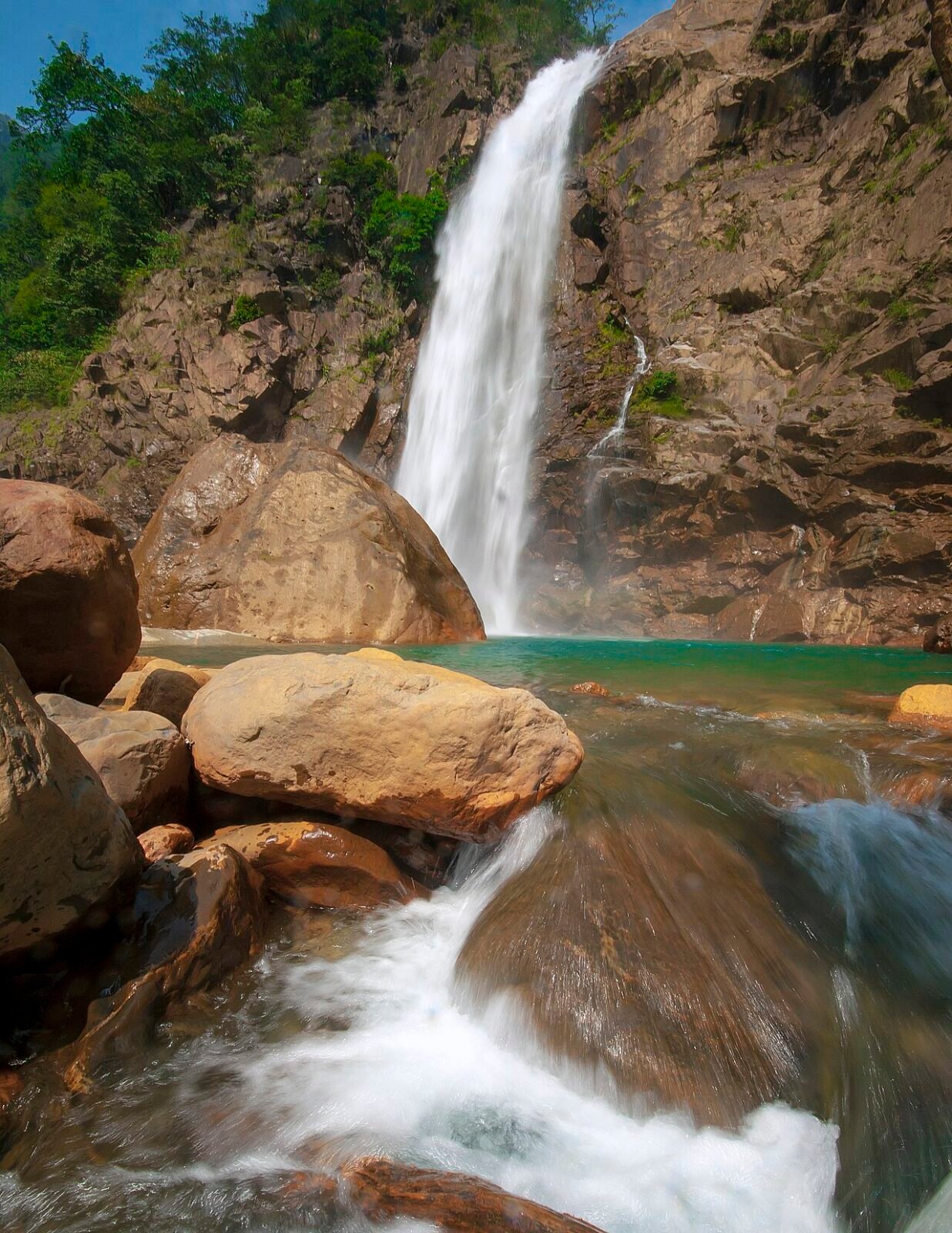
Rainbow Falls lies beyond the double-decker, about 3 km further on over rougher, mostly uphill ground. Trek reports put it at 1 to 2 hours each way, with the return a little quicker. The waterfall drops into a deep blue pool, and on sunny mornings the spray throws the rainbow it is named after.
On a day trip, adding Rainbow Falls usually means a very long day and a climb back up in the late afternoon. It is far more comfortable from an overnight stay in Nongriat: walk there in the morning when the light is good, come back, then start the climb. After heavy rain, the path can be closed or unsafe; your guide will know.
Guides, fees and the rules you should know
Since July 2025, the East Khasi Hills district administration has required tourists to use registered local guides for treks and outdoor activities in the district, which covers Sohra and Nongriat. The district’s notice is on the Meghalaya government website. Check that the rule is still in force when you book, but plan on hiring a guide either way: they know the trail, the wire bridges and the weather, and the money stays in the village. Ka Hima Sohra, the traditional council that governs the area, also requires local guides on its trails, and has banned picnics and open-air cooking in sensitive spots and asks every vehicle to carry a waste bag.
- Fees: the village collects a small fee at the double-decker. Trek reports put it at around ₹20 per person, with a separate camera fee (more for GoPros and video cameras), but no official rate is published, so carry small notes in cash.
- Don’t climb on the roots. The bridges are living trees. Walk across the deck, but don’t scramble up the root walls for photos.
- Carry your rubbish out. There is no waste collection at the bottom. Take a bag for wrappers and bottles.
- Respect village life. Ask before photographing people or homes, and keep music off on the trail.
What to carry and wear in winter
December and January days in the valley are mild, but mornings in Sohra are cold and fog can roll in fast.
- Shoes with a good grip. Wet stone steps are slippery; flat-soled sneakers are a common mistake.
- Two litres of water each, plus snacks. Tea stalls exist on the way, but don’t rely on them early in the day.
- A light rain jacket, even in the dry season.
- A warm layer for the start and for the evening if you stay overnight.
- Cash for the guide, any fees, food and a homestay.
- A small torch or phone torch, in case the climb runs late.

A 3-day Shillong, Sohra and Nongriat plan for December
This plan assumes you fly or take the train into Guwahati and want the trek to be the centrepiece without rushing it.
- Day 1: Guwahati to Shillong. Drive up in the afternoon, stop at Umiam Lake on the way, and spend the evening around Police Bazar. Sleep in Shillong.
- Day 2: Shillong to Sohra and down to Nongriat. Leave Shillong early, reach Tyrna by late morning with your guide and walk down. Spend the afternoon at the double-decker and sleep in a Nongriat homestay.
- Day 3: Rainbow Falls and back up. Walk to Rainbow Falls early, return to Nongriat, climb back to Tyrna by early afternoon and drive to Sohra or Shillong. If you still have energy, Nohkalikai viewpoint and Mawsmai Cave are close to Sohra.
Short on time? Make Day 2 a day trip from Sohra and skip Rainbow Falls. Our Shillong Cherry Blossom Festival guide covers Shillong itself in more detail, and the Hornbill Festival guide pairs well if you are heading on to Nagaland in early December. For another Northeast trip that rewards slow travel, see our Majuli island guide.
Double decker root bridge trek FAQs
How many steps are there on the double decker root bridge trek?
Meghalaya Tourism gives two figures on the same page: about 3,000 and about 3,500 stone steps from Tyrna down to Nongriat. Expect roughly that many, and the same number again on the way back up.
How long does the Nongriat trek take?
The Ministry of Tourism’s rural tourism listing puts Tyrna to Nongriat at about two hours. Most people take longer on the climb back. Plan for a full day if you are going down and up in one go.
Can I do the double decker root bridge trek as a day trip?
Yes, if you are reasonably fit and start from Tyrna by about 8 am. Base yourself in Sohra rather than Shillong to cut the morning drive. Skip Rainbow Falls on a day trip unless you are a strong walker, as it adds roughly 3 to 4 hours there and back.
Do I need a guide for Nongriat?
Since July 2025, the East Khasi Hills district administration has required tourists to use registered local guides for treks in the district. Confirm the current rule when you book, and arrange a guide through your hotel or in Tyrna.
What is the best time for the double decker root bridge trek?
October to March, when the steps are drier and the streams are lower. The monsoon months bring very heavy rain, slippery steps and swollen streams.
Is there a place to stay in Nongriat?
Yes, there are simple homestays and guest houses run by village families. Facilities are basic and you pay in cash. Book ahead in December, when the whole Sohra area is busy.
Featured image: double-decker living root bridge at Nongriat by Arijit Sahu, CC BY-SA 4.0, via Wikimedia Commons. Facts checked on 21 November 2026 against the Meghalaya Tourism Nongriat page, the Ministry of Tourism rural tourism listing, the East Khasi Hills notice on guides and PTI’s report on the BBC list. Trail conditions change after rain; check with your guide before you set off.


Pingback: Where to Eat in Shillong (2026): 4 Best Picks for Khasi Food